

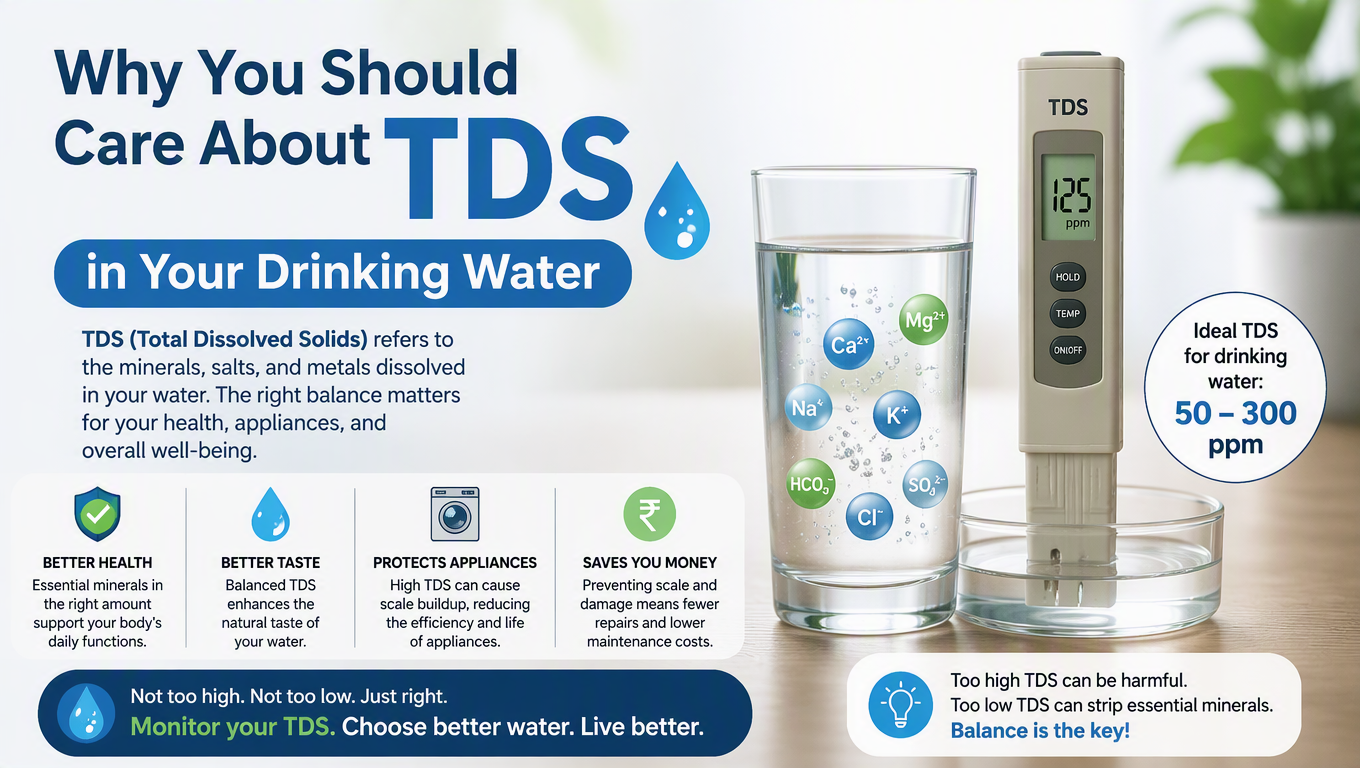
Why You Should Care About TDS in Your Drinking Water Leave a comment
You’ve probably seen the term TDS on water filter packaging or in product descriptions. Maybe you’ve even seen a TDS meter reading on a water purifier display. But what does it actually mean?
Let’s break it down.
What Is TDS?
TDS stands for Total Dissolved Solids. It’s a measure of everything that’s dissolved in your water. Minerals, salts, metals, and other organic compounds. When water passes through rocks, soil, and pipes, it picks up these particles along the way.
Some dissolved solids are harmless. Minerals like calcium and magnesium are actually good for you. But other dissolved solids include heavy metals, chlorine, and chemical residues. Those are less welcome.
How TDS Affects Your Water
High TDS levels can affect more than just taste. They can leave scale buildup on your appliances and pipes. They can make your water feel hard or leave spots on your dishes. In some cases, high TDS can indicate contamination that affects safety.
Most municipal water supplies are treated to meet safety standards, but water can pick up impurities between the treatment plant and your tap. Older pipes, aging infrastructure, and groundwater sources can all introduce dissolved solids.
What’s a Good TDS Reading?
A reading of 50-150 ppm (parts per million) is generally considered good for drinking. Anything above 500 ppm starts to affect taste. Above 1000 ppm, water can taste noticeably salty or metallic, and many health authorities recommend against regular consumption.
Reverse osmosis systems are highly effective at reducing TDS. They can remove 85-99% of dissolved solids, bringing readings down to 10-50 ppm. That’s why you’ll often see a TDS meter on RO systems.
Real-time Monitoring Matters
Some water purifiers let you see the TDS level in real time. You can compare unfiltered tap water with filtered water instantly. That transparency gives you confidence that your filter is actually working.
It also lets you know when it’s time to replace your filter. As the membrane degrades or reaches the end of its life, you’ll see TDS readings creep back up. That’s your signal to change the filter.
The Bottom Line
TDS is a useful measure of water quality. It’s not the only metric that matters, but it’s a good starting point. If you’re concerned about your drinking water, a reverse osmosis system with TDS monitoring gives you clean water and the data to prove it.
