

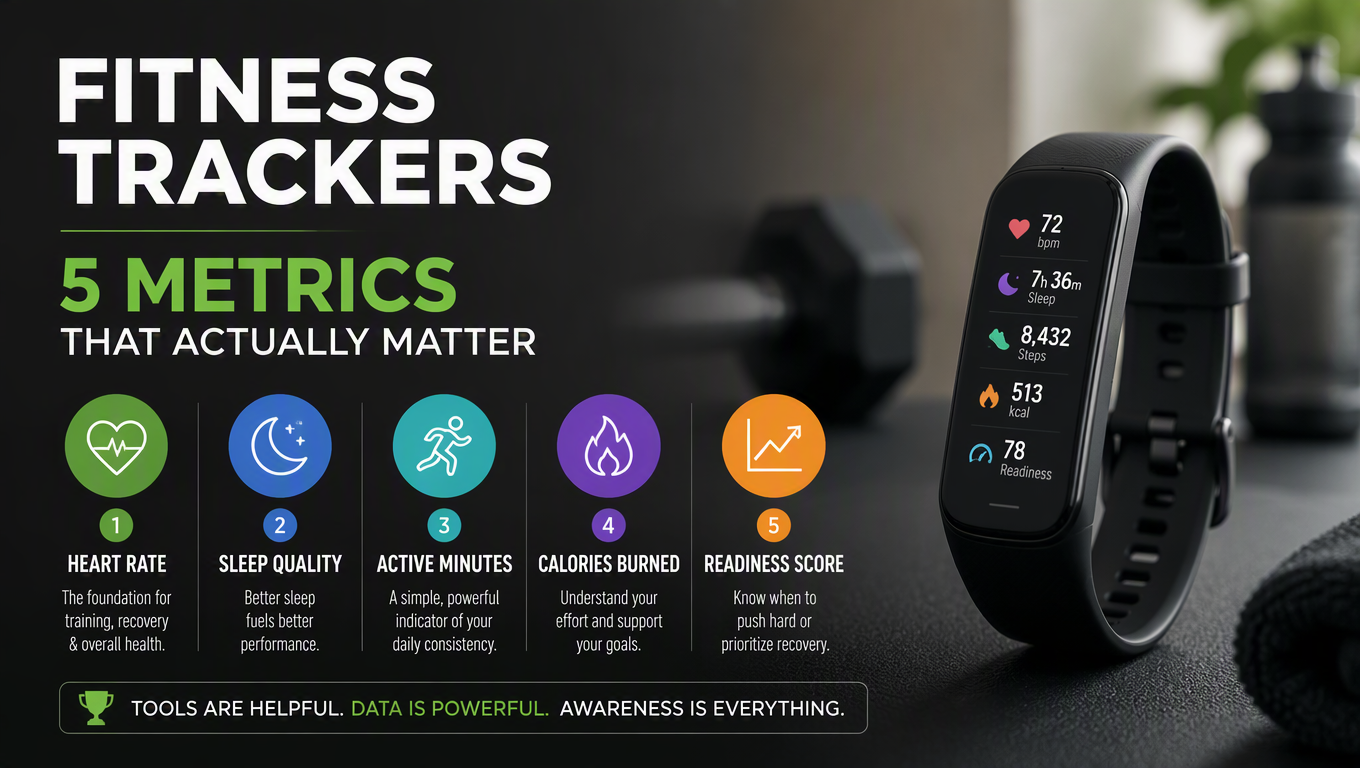
Fitness Trackers – 5 Metrics That Actually Matter (And 3 That Don’t) Leave a comment
Your Tracker Is Collecting Data. But What Does It Mean?
You bought a fitness tracker. Good. You’re wearing it. Also good.
Now you’re drowning in data. Steps. Calories. Heart rate. Sleep stages. Active minutes. Floors climbed. Stress score. VO2 max. Recovery time.
Which numbers actually matter? Which are just noise?
Let’s cut through the confusion.
The 5 Metrics That Actually Matter
1. Steps (or Active Minutes)
Why it matters: Movement is the foundation of health. Walking is the most underrated exercise.
What to track: 7,000-10,000 steps per day. Or 150 active minutes per week.
How to improve: Park farther from the store. Take the stairs. Walk while on phone calls. Get a walking pad for your desk.
2. Sleep Duration
Why it matters: Sleep affects everything — mood, energy, immune system, weight, and brain function.
What to track: 7-9 hours for adults. Consistency matters as much as duration.
How to improve: Same bedtime every night. Dark, cool room. No screens 1 hour before bed.
3. Resting Heart Rate (RHR)
Why it matters: Lower resting heart rate = better cardiovascular fitness. Also a leading indicator of illness (RHR rises before symptoms appear).
What to track: 60-80 bpm is average. 50-60 bpm is fit. Below 50 is athlete territory.
How to improve: Cardio exercise. Better sleep. Less alcohol. Lower stress.
4. Heart Rate Variability (HRV)
Why it matters: HRV measures the variation between heartbeats. Higher HRV = better recovery, lower stress, healthier nervous system.
What to track: Compare to your own baseline (not to others). Higher than your average is good.
How to improve: Better sleep. Less alcohol. Manage stress. Recovery days after hard workouts.
5. Deep Sleep (or Sleep Quality)
Why it matters: Deep sleep is when your body repairs itself. Immune system boosts. Muscles recover. Tissues regenerate.
What to track: 1.5-2 hours of deep sleep per night (20-25% of total sleep).
How to improve: Consistent sleep schedule. Cool bedroom (18-20°C). No alcohol before bed. Dark room.
The 3 Metrics You Can Probably Ignore
1. Calories Burned
Why you can ignore it: Fitness trackers are notoriously inaccurate at estimating calories. Off by 20-50% is common.
What to do instead: Focus on steps and active minutes. Track food intake separately if weight loss is your goal.
2. Floors Climbed
Why you can ignore it: Barometric pressure sensors (how trackers measure floors) are inaccurate. A gust of wind can register as a floor.
What to do instead: If you want to climb stairs, climb stairs. Don’t trust the number.
3. “Readiness Score” or “Body Battery.”
Why you can ignore it: Proprietary algorithms vary wildly between brands. They’re often just a fancy way of repackaging HRV and sleep data.
What to do instead: Look at your actual sleep duration, HRV, and how you feel. You don’t need a “score.”
How to Actually Use Your Tracker
Do: Look for trends over time
Your resting heart rate has been creeping up for two weeks. You’ve been sleeping worse. You feel tired.
Action: Take a rest day. Go to bed earlier. Skip the alcohol.
Don’t: Obsess over daily fluctuations
Your steps were 8,500 yesterday and 7,200 today. That’s fine. Life happens.
Action: Zoom out. Look at weekly averages, not daily numbers.
Do: Use it as a tool, not a judge
Your tracker isn’t grading you. It’s giving you data.
Action: Ask “what can I learn from this?” not “am I good enough?”
Don’t: Wear it 24/7 if it stresses you out
Some people become obsessed with the numbers. If that’s you, take breaks.
Action: Wear it for a week. Learn. Then put it in a drawer for a week. Recharge mentally.
What a Healthy Week Looks Like (Data Edition)
| Metric | Target |
|---|---|
| Steps | 8,000-10,000 per day |
| Active minutes | 30-60 per day |
| Sleep duration | 7-9 hours per night |
| Deep sleep | 1.5-2 hours per night |
| Resting heart rate | Within 5 bpm of your average |
| HRV | Stable or improving |
Real Customer Story
“I was obsessed with my step count. I’d pace around my living room at 11 PM to hit 10,000. My tracker was controlling me. Then I learned to focus on weekly averages instead of daily goals. Now I’m less stressed and still active.”
— Alex B.
ChetaXpress Fitness Tracker Recommendation
| Model | Best For | Key Features |
|---|---|---|
| 2026 Fitness Tracker | Beginners, budget-conscious | Heart rate, sleep tracking, steps, calories, waterproof, 10+ languages |
More models coming soon.
Ready to Track What Matters?
Your shortcut to better health starts with the right data.
👉 Shop Fitness Trackers at ChetaXpress
Tags: #FitnessTracker #HeartRate #SleepTracking #HealthData #WearableTech #ChetaXpress
Want these delivered to your inbox?
👉 Subscribe to the ChetaXpress Newsletter
ChetaXpress — Your shortcut to a smarter life
