

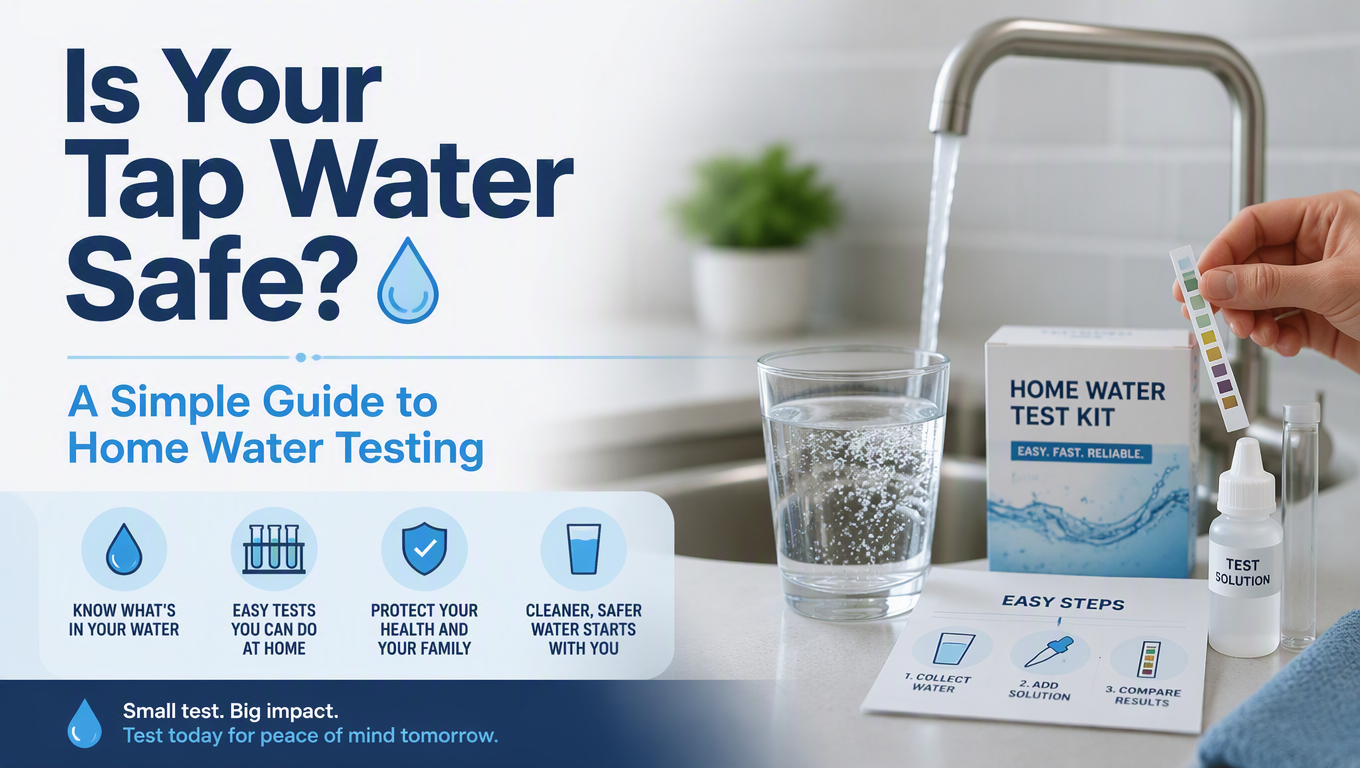
Is Your Tap Water Safe? A Simple Guide to Home Water Testing Leave a comment
You turn on the tap, fill a glass, and drink. You assume the water is safe. Most of the time, it is.
But not always.
What’s in Your Water?
Municipal water is treated to meet safety standards. But it can still contain trace amounts of chlorine, chloramine, sediment, and dissolved minerals. Sometimes, it picks up contaminants from old pipes between the treatment plant and your home.
Well water carries its own risks. It can contain bacteria, heavy metals, nitrates, and other contaminants that aren’t regulated the same way as municipal supplies.
Common Contaminants
| Contaminant | Source | Health Concern |
|---|---|---|
| Chlorine | Water treatment | Affects taste and odour |
| Lead | Old pipes | Accumulates in the body. Harmful over time. |
| Nitrates | Agricultural runoff | Harmful to infants and pregnant women. |
| Pesticides | Agricultural runoff | Long-term health risks. |
| Hard water minerals | Natural deposits | Scale buildup. Affects appliances. |
| pH imbalance | Natural or treatment | Corrosive or scaling potential. |
How to Test Your Water
There are different ways to test water quality, depending on how detailed you want to be.
Simple TDS Testing
A TDS meter measures total dissolved solids. It gives you an overall sense of water purity. Lower readings generally mean better water.
This won’t tell you what the dissolved solids are. But it tells you if there’s been a sudden change in your water quality.
The 10-Parameter Test
More advanced testers check pH, TDS, EC, ORP, salinity, resistivity, temperature, and more. That’s useful if you need to monitor water for multiple applications.
Fish tanks, hydroponic systems, pools, and spas all benefit from this level of detail.
Professional Testing
For a complete picture, send a sample to a certified lab. They can test for bacteria, heavy metals, pesticides, and other contaminants.
This is the most thorough option, but it costs time and money. Most people only need it if they suspect a specific problem.
What to Do If You Find Problems
If your water is hard, a water softener helps. If there’s chlorine or sediment, a simple filter or RO system does the job.
If you find serious contamination, contact your water supplier or local health department.
A Simple Alternative
If you’re concerned but don’t want to test regularly, installing a reverse osmosis filter under your sink removes most common impurities. You don’t need to test as often, because the filter handles a wide range of contaminants.
The Bottom Line
Your tap water is usually safe to drink. But knowledge is better than assumption. A simple water tester gives you confidence and helps you catch issues early.
